MMIC LPF Builder: from a filter spec to an HFSS-verified lumped MMIC layout
A local web tool that turns a filter spec into a lumped filter laid out on a GaAs MMIC process and verified in full-wave EM. Low-pass and high-pass run end to end; band-pass runs at circuit level.
The flow
- Spec: band edges, return loss, insertion loss, rejection.
- Synthesis: a synthesis and tuning tool gives the ladder (elliptic with shunt traps, or Chebyshev).
- Cells: each L and C becomes a reusable parametric 3D component (square spiral or MIM capacitor), sized from HFSS characterizations.
- Build: a pyaedt script builds the filter in classic HFSS with a tuning port in every cell. A rule-based trap check resizes any trap whose notch lands more than 4 % off.
- Port tuning: the same HFSS N-port is tuned in two engines, the synthesis and tuning tool and AEDT Circuit.
- Verification: tuned values resize the cells and HFSS solves the real filter, looping until it meets the mask.
Results
- 10 GHz elliptic low-pass (N = 5): meets its own mask in HFSS at the first tuning pass in three runs, with 0.85 to 0.86 dB loss, 18.0 to 18.3 dB return loss and 30.3 to 30.6 dB rejection.
- Also verified: 6 GHz (pass 1), 8 GHz (pass 4), 12 GHz (pass 3), and a 10 GHz elliptic high-pass (pass 5: 16.07 dB return loss, 31.8 dB rejection, 0.70 dB loss). At 15 GHz the lumped traps run out, and the tool reports the miss.
- Synthesis matches textbook values: 64 of 64 elements within 1 %.
- Spec to verified filter in about 8 to 10 minutes, unattended.
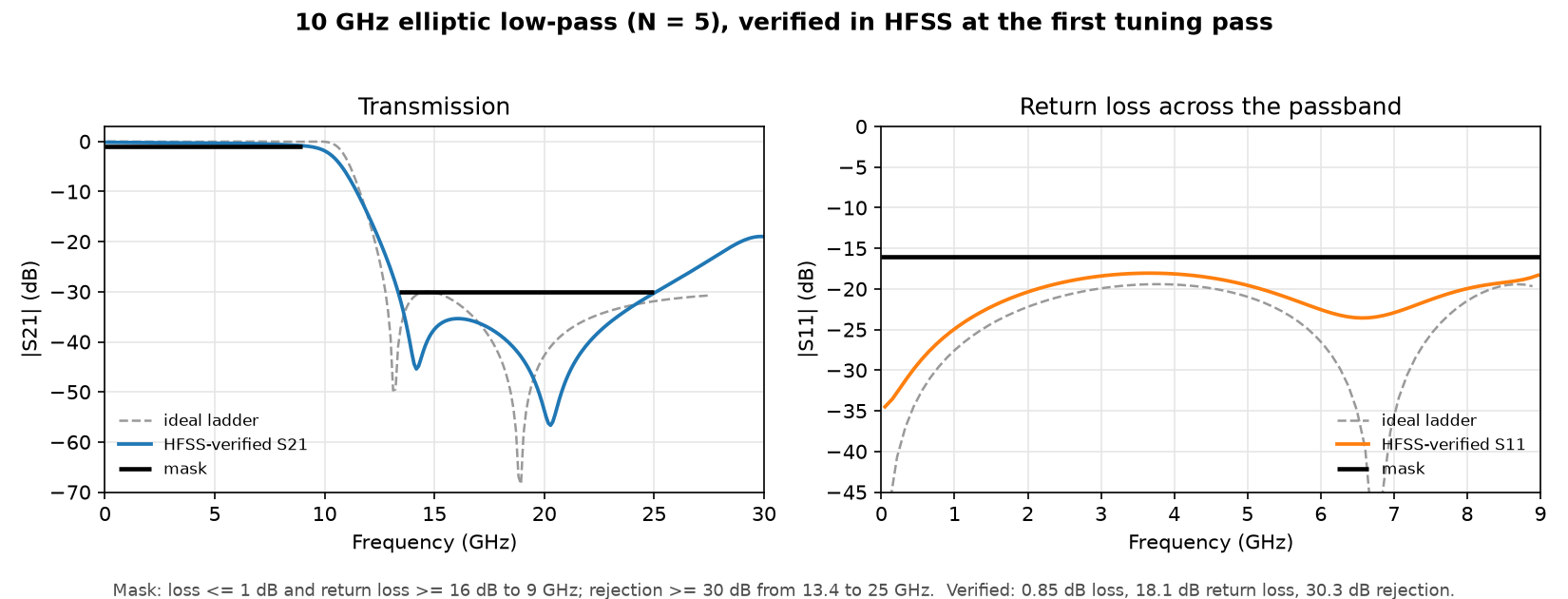 10 GHz elliptic low-pass (N = 5), verified in HFSS at the first tuning pass.
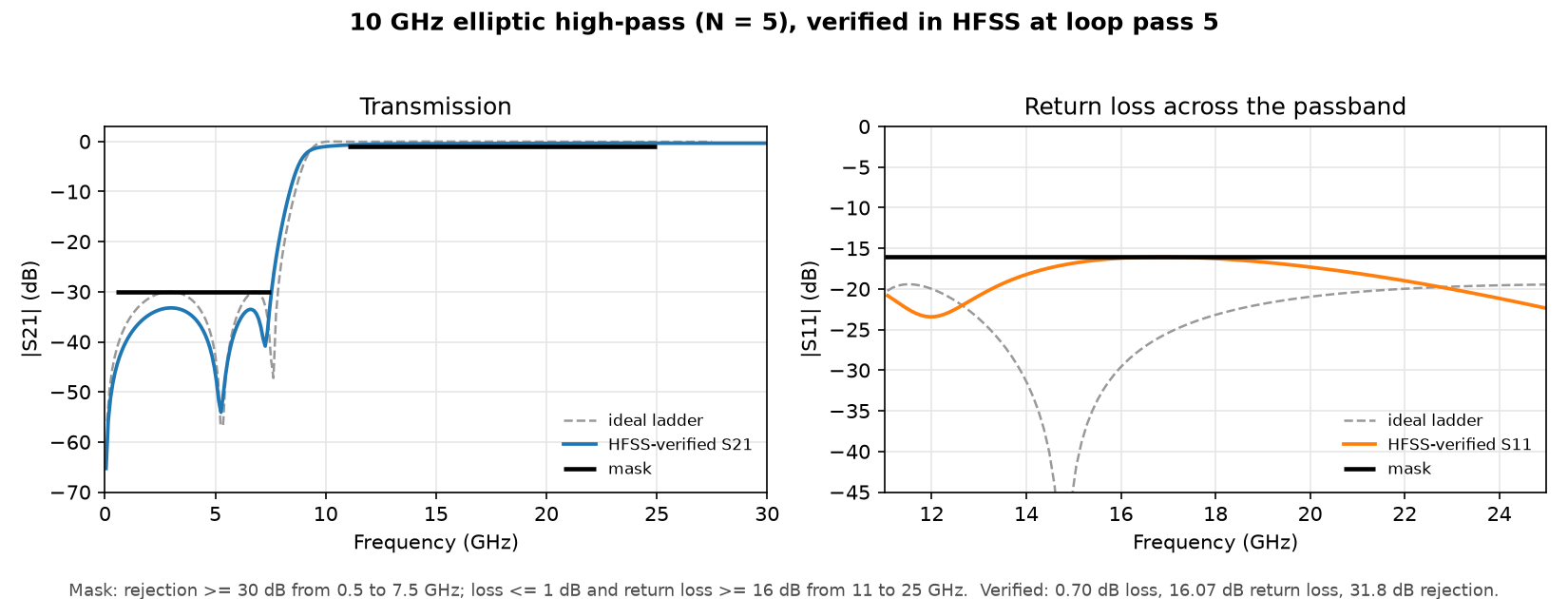 10 GHz elliptic high-pass (N = 5), verified in HFSS at loop pass 5.
The build is deterministic scripting: the same spec gives the same model every run, with no AI in the loop at run time.