Parallax: telling an AI agent where its drawing is wrong
The problem
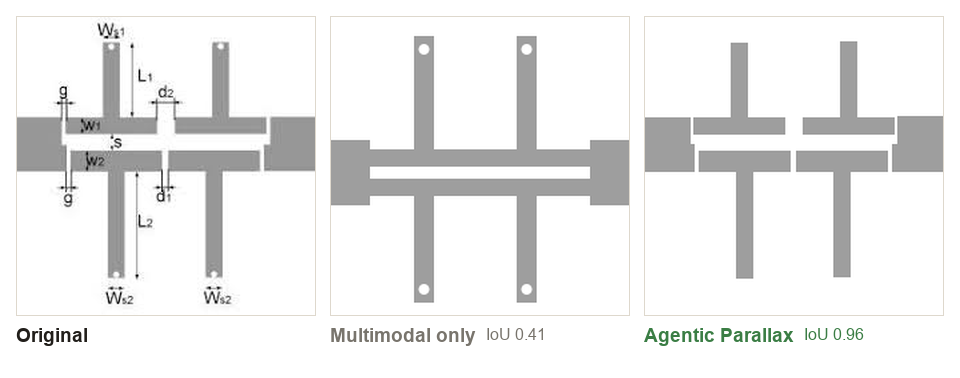
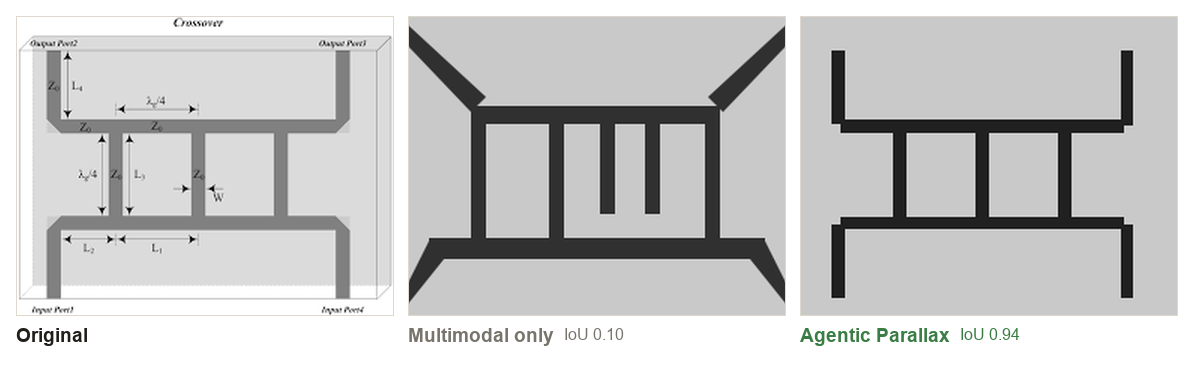
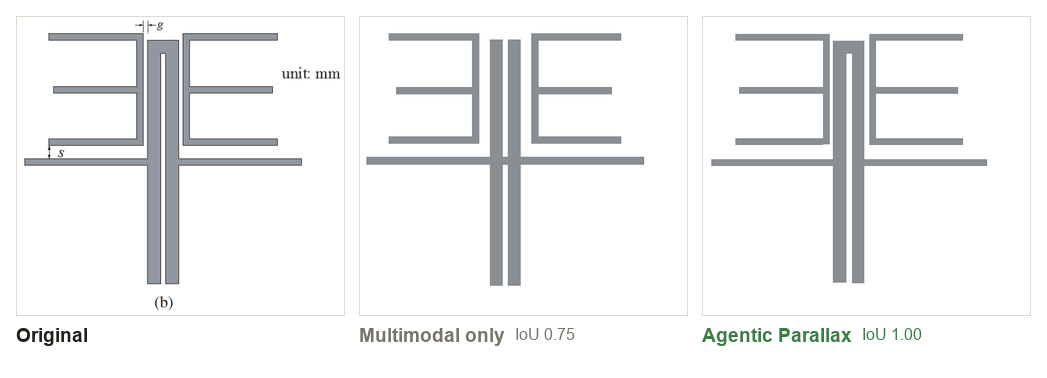
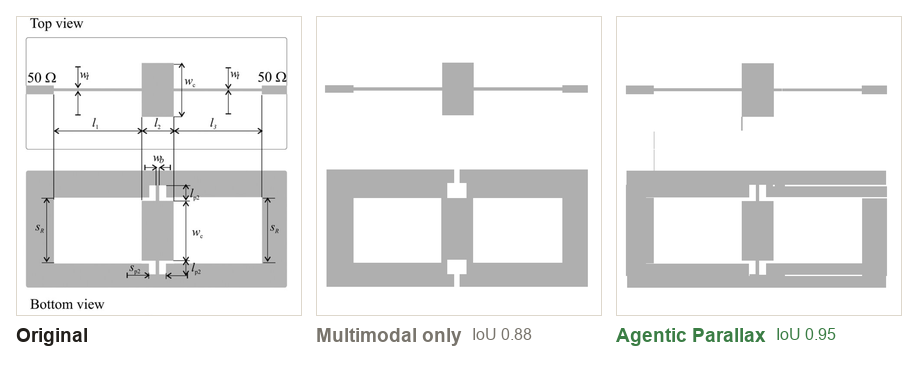
Published engineering figures, such as PCB traces and RF filter layouts, are covered in dimension arrows and labels. Ask a multimodal model to redraw the traces and it gets the rough shape but invents the proportions. To rebuild a design from a figure, an agent needs to know where its drawing is wrong, by how much, and which part to fix.
The pipeline
Parallax runs five phases on every attempt:
- Ingest the reference: colour profile, scale and render parameters. It detects six trace and background styles on its own, from grey on white to copper traces and dark traces on a grey substrate.
- Decompose it into a binary trace mask and its connected components.
- Compare the agent’s render with the original: IoU, a pixel diff, and error regions tagged with the component that needs fixing.
- Crop the worst error regions side by side.
- Report a compact
agent_contextblock that the agent pastes into its next correction.
The agent iterates: read the report, fix its drawing script, re-render, and run Parallax again until the IoU converges.
Measuring the right thing
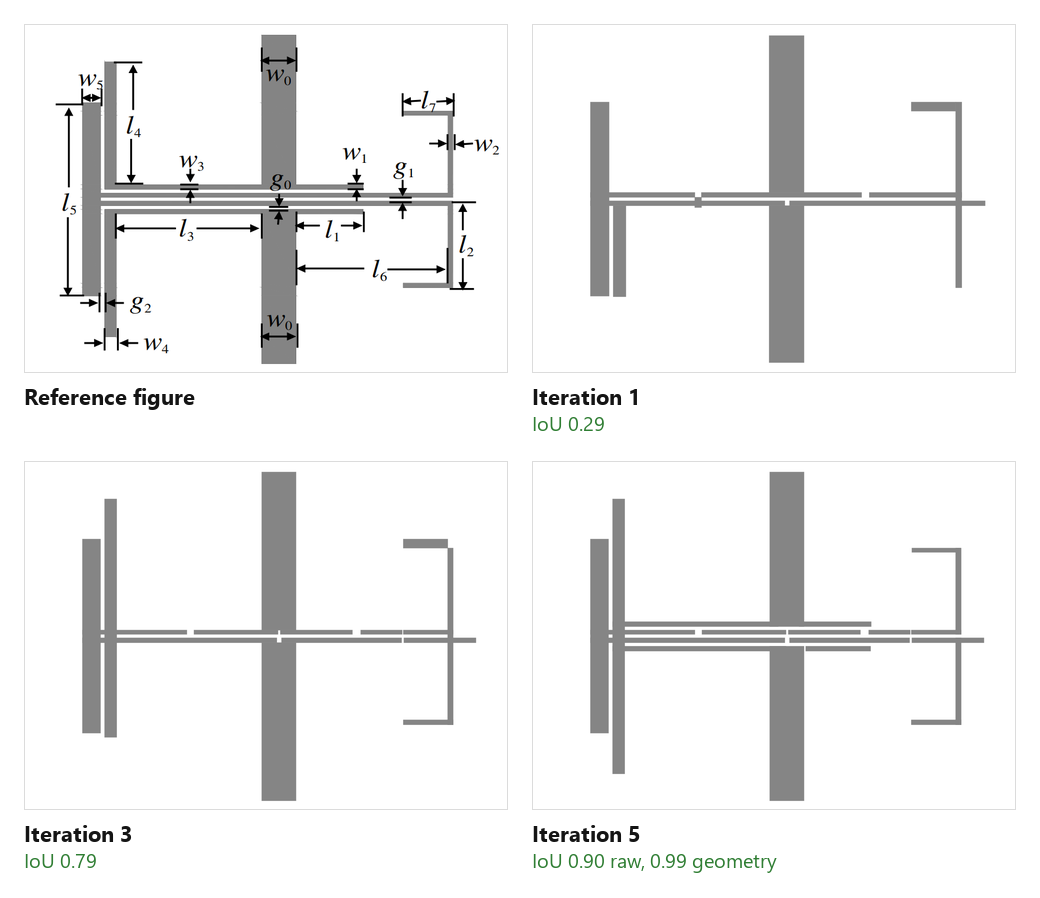
On a Ku-band filter, raw IoU stalled near 0.90 and looked like a ceiling. It wasn’t the geometry; it was the annotations. Dimension lines cross the traces in the reference figure, so even a perfect reconstruction can’t match those pixels. Masking annotation pixels out of the score, and later detecting the grey leader lines too, moved the same fifth iteration from 0.904 raw to 0.992 geometry IoU.
Results
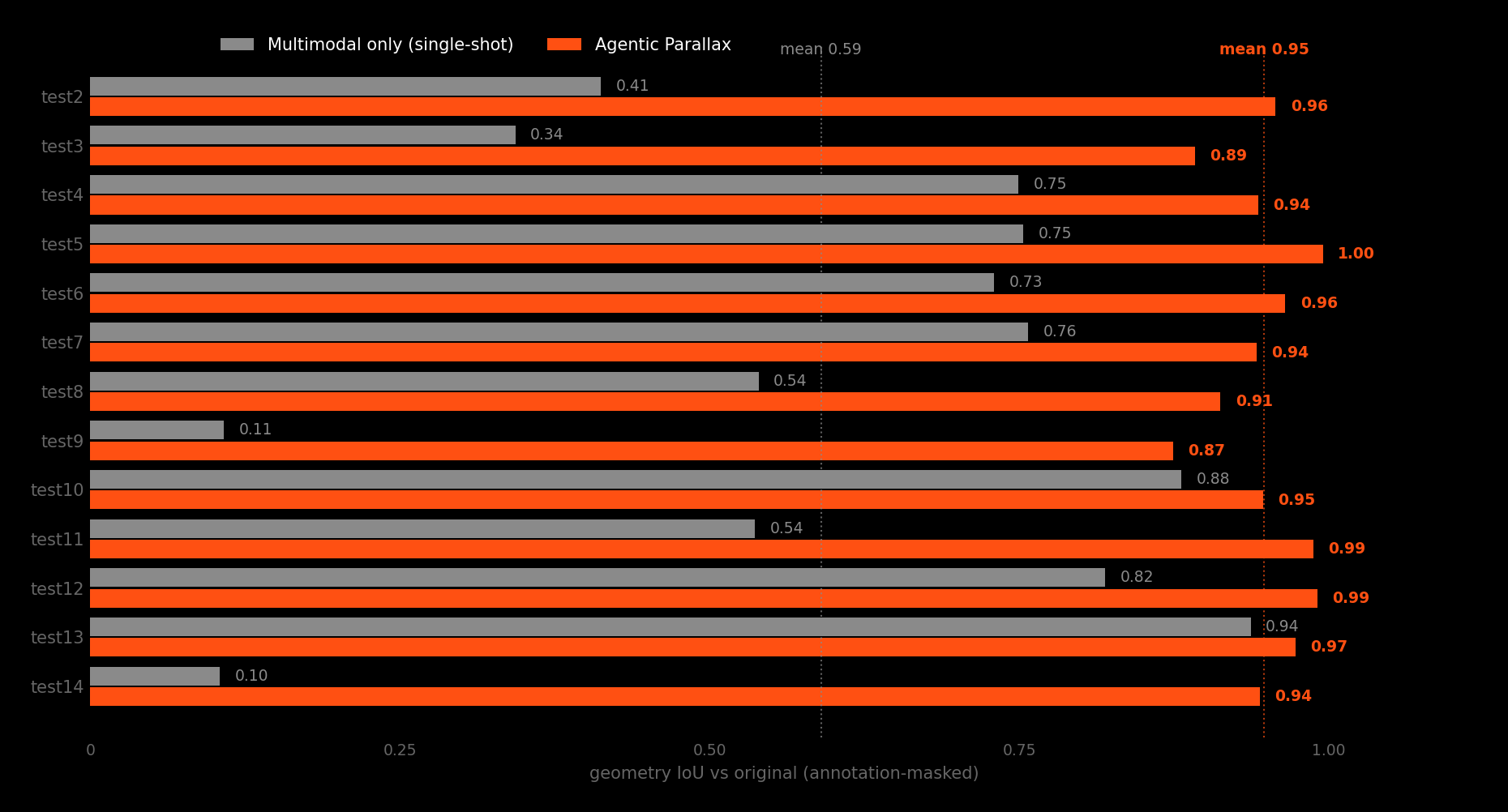
- Agentic vs single-shot: with the same model on 13 diagrams, Parallax won every one, with mean geometry IoU 0.95 against 0.59. The biggest gains came where the model misread the figure entirely: a crossover went from 0.10 to 0.94, and a hollow-outline schematic from 0.11 to 0.87.
- From iterating to extracting: a later version extracts the geometry from the pixels itself and nudges every edge to maximise the masked IoU. On the Ku-band filter that first draft scored 0.997 with no model iterations at all, beating the 0.992 that five iterations had reached. The model’s job changed from guessing geometry to reviewing a machine-extracted draft, which is easier to check.