RF Bench: Interactive RF Fundamentals
Open RF Bench → It runs entirely in your browser. There’s nothing to install.
Overview
RF Bench is a set of small interactive benches for the ideas RF engineers use every day. Each tab puts a circuit or a layout on the left and live plots on the right, with the equations filled in with your numbers underneath. Drag a part, move a slider, and see the physics respond.
What’s inside
- Mismatch: Γ, return loss and VSWR from one load, with the standing wave, a draggable Smith chart and a conversion ruler.
- Resonator & Q: L and C set f₀; metal loss sets unloaded Q; the coupling gap sets external Q. Includes ring-down.
- Matching: a low-impedance die to 50 Ω with L-networks and quarter-wave sections, and why a bigger ratio means less bandwidth.
- Splitter: why Wilkinson arms step wider toward the outputs, with lines drawn to scale on GaAs or RO4003C.
- PA load line: why a big transistor wants a few ohms, with an interdigitated transistor layout you can grow.
- Coupled resonators: mode splitting, the coupling coefficient k, external Q from the tap, and electric vs magnetic coupling.
- Filter order: how many poles a bandpass filter needs, and what each extra pole costs in loss.
- Low-pass filter: a guided 60-minute lesson, from the prototype ladder to a stepped-impedance layout.
- Drills: mixed number drills that come back to the card types you miss.
How it’s meant to be used
Each tab asks you to predict a number before it shows you the answer, then explains the gap. The drills interleave topics on purpose, so you practise choosing the right formula, not just applying it.
Tech: plain HTML, CSS and JavaScript with hand-drawn SVG plots. No framework, no server.
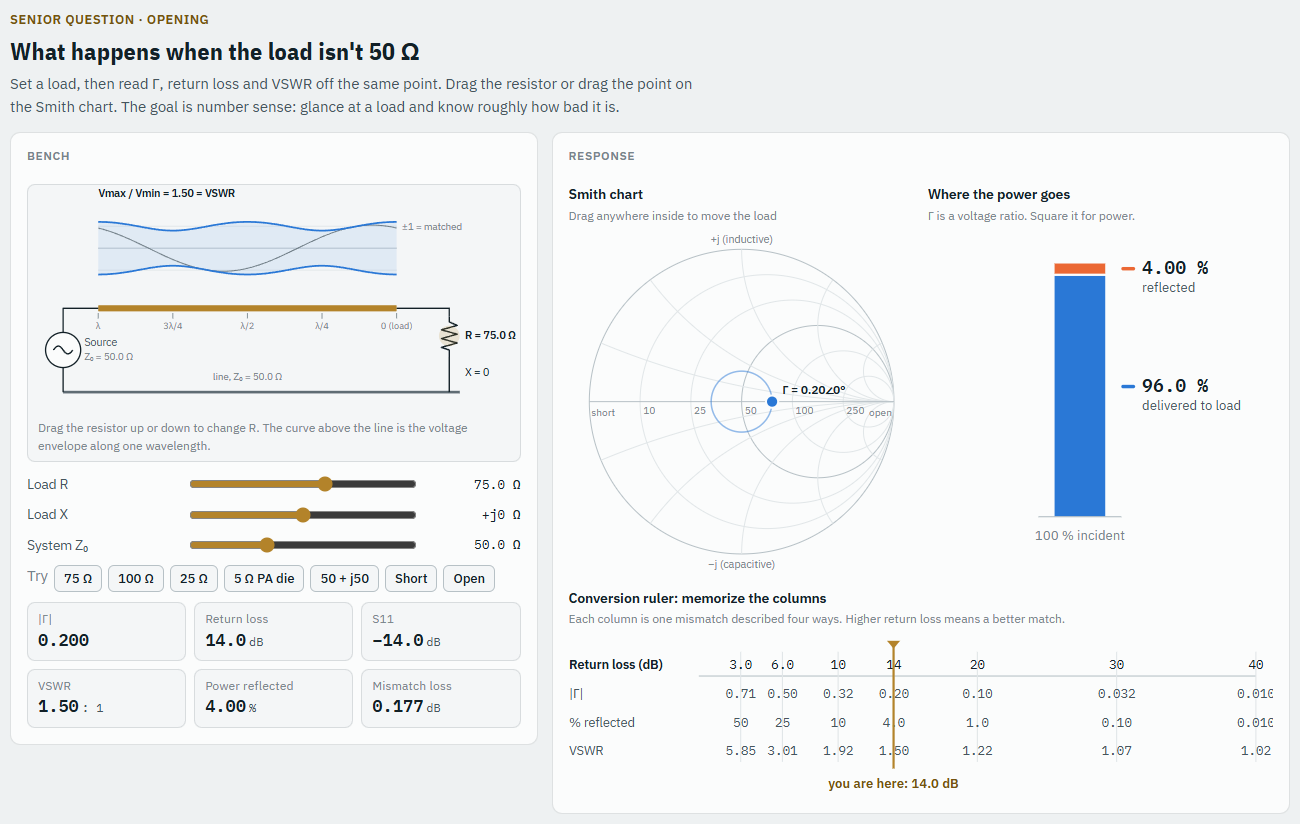 Mismatch: pick a load and read Γ, return loss and VSWR off the same point.
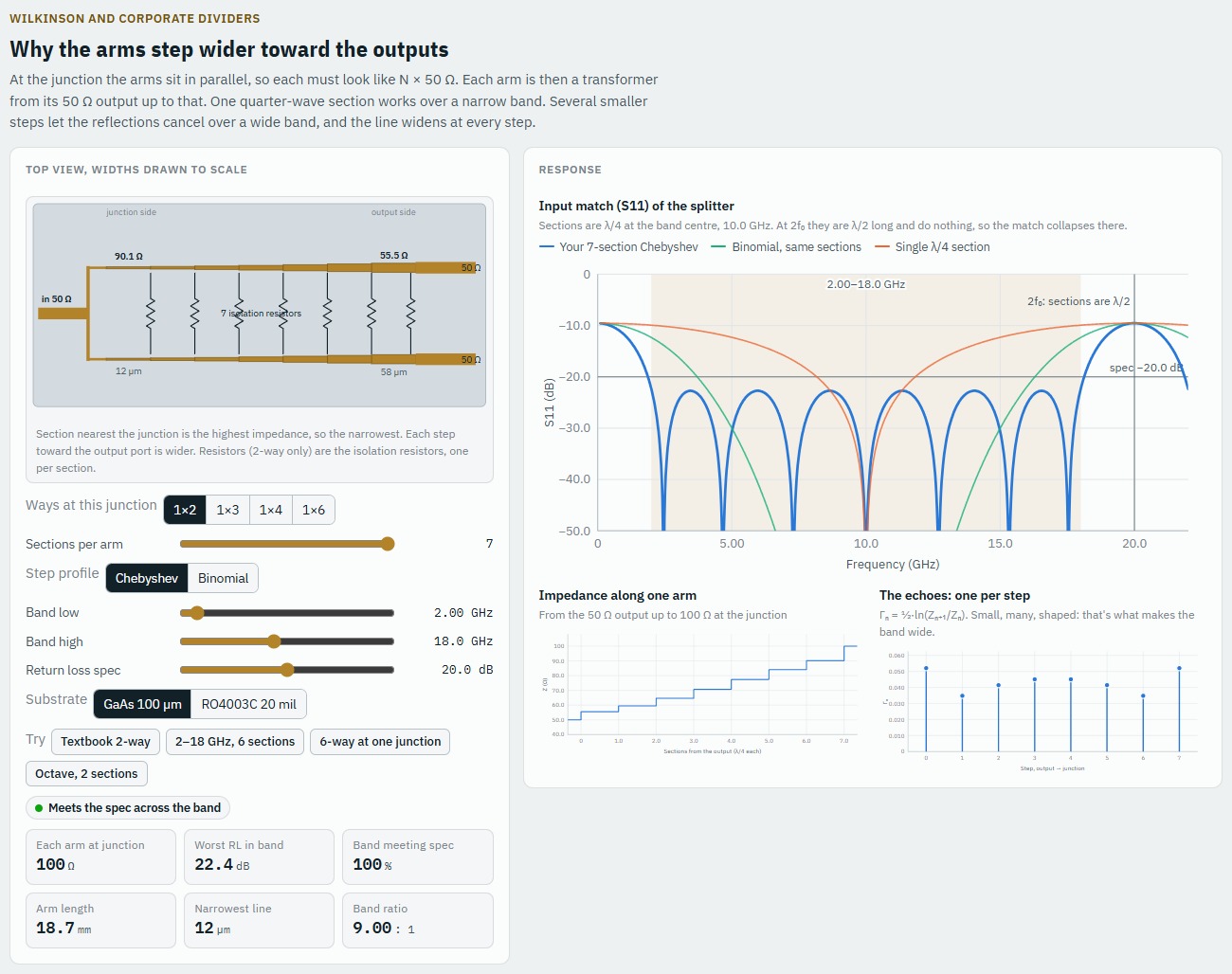 Splitter: a 7-section Chebyshev arm covers 2 to 18 GHz at 20 dB return loss. The narrow lines near the junction are the high-impedance sections.
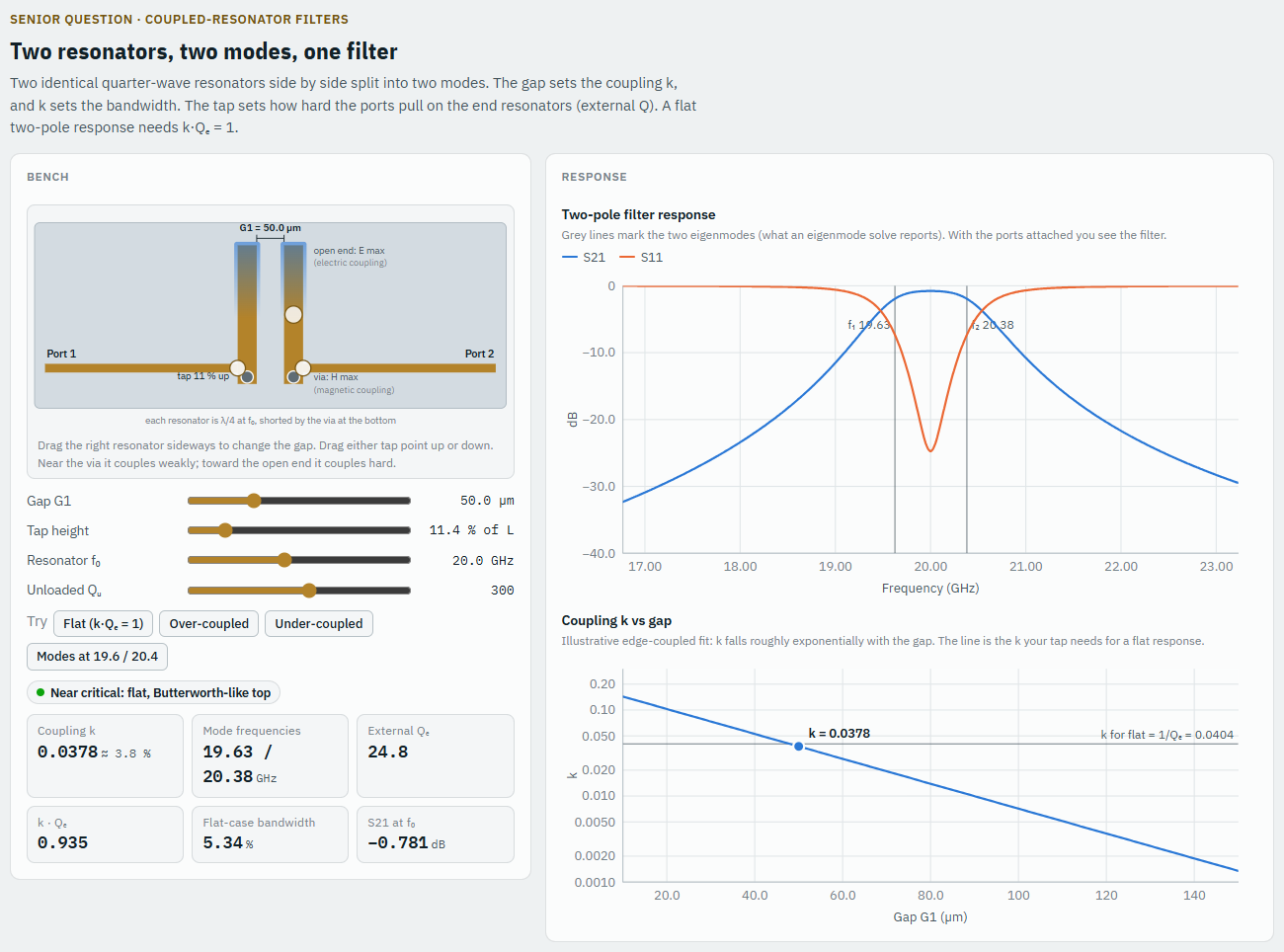 Coupled resonators: the gap sets k, the tap sets Qₑ, and the two-pole response goes flat when k·Qₑ = 1.