FDTD, FEM or MoM? An EM Solver Guide
Open the guide → · Source on GitHub
It runs in your browser. There’s nothing to install.
Overview
The guide explains how FDTD, FEM and MoM work and when to use each one.
- Devices in 3D: 20 devices, from an on-chip spiral to a ship, each with the real mesh made with Gmsh: FEM tetrahedra, an FDTD Yee grid and MoM surface triangles.
- How each solver works: step-by-step 3D lessons on the Yee cell, the tetrahedron and the RWG basis function, each with a short quiz.
- Convergence: when is each solver done? Demos include FEM adaptive passes, an FDTD ring-down, the Courant limit and a thin-wire MoM solve of a dipole that runs in the browser.
- Picker: set the size, frequency and problem type, and the method ranking and the first tools to look at update live.
- Tools: data for 62 commercial, open-source and free tools, with paper counts from OpenAlex.
- Companion page, Rays, PO or Hata?: ray tracing, physical optics, diffraction (UTD and knife-edge), SBR and empirical planning models, each with a live demo checked against an exact reference.
- Companion page, Meshing for FEM: Delaunay insertion, advancing front, Ruppert refinement, size fields, 3-D slivers and an adaptive FEM loop on the L-shaped benchmark, from the original papers.
Tech: one self-contained HTML file with three.js. The meshes come from Gmsh scripts in the repo.
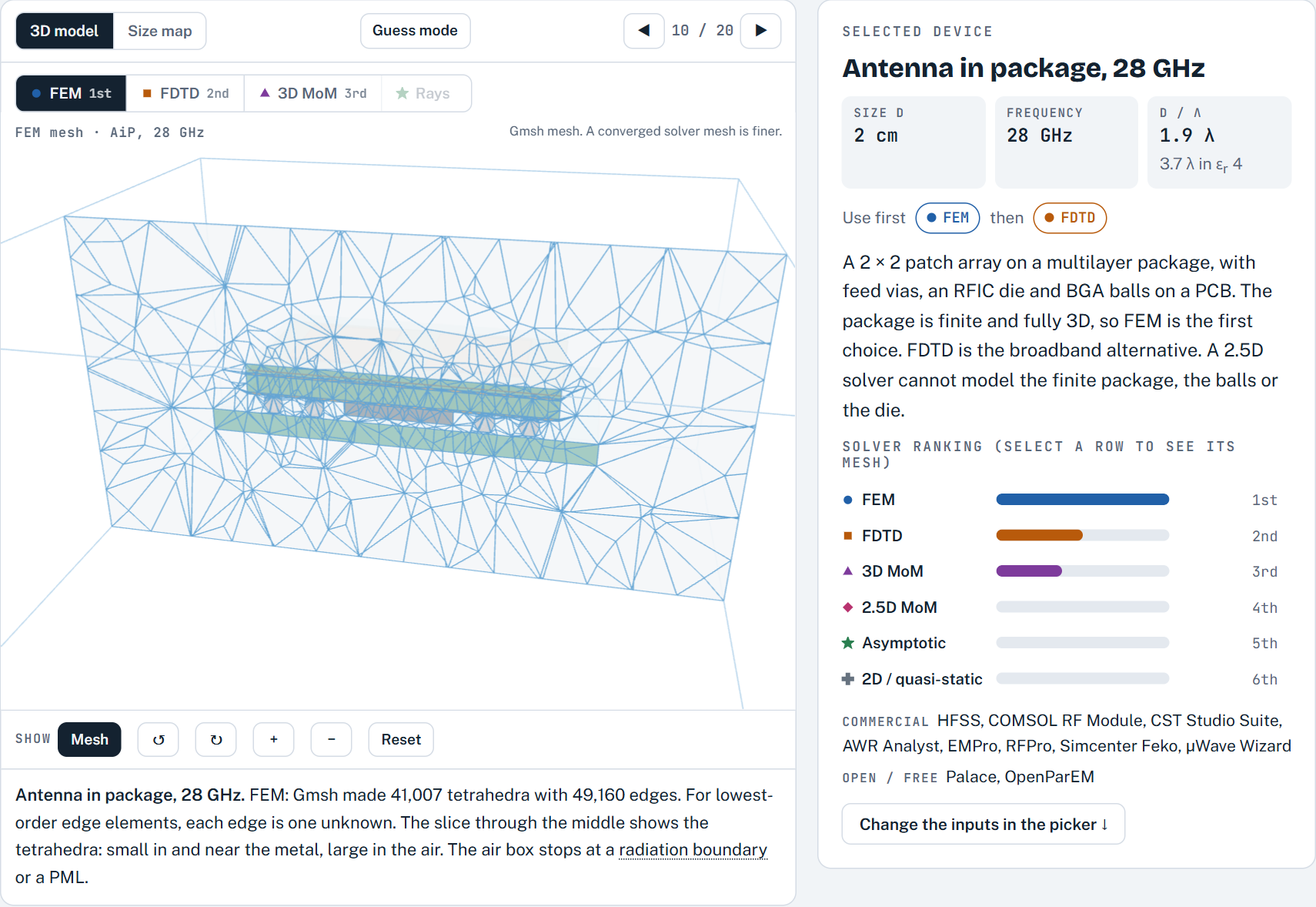 The FEM mesh of a 28 GHz antenna in package, with the solver ranking for that device.