Convolutional Neural Network to Predict Breathing Patterns
Project Overview:
The goal of this project was to train a convolutional neural network (CNN) to predict breathing waveforms from simulated phase from radar reflected off of a breathing human’s chest.
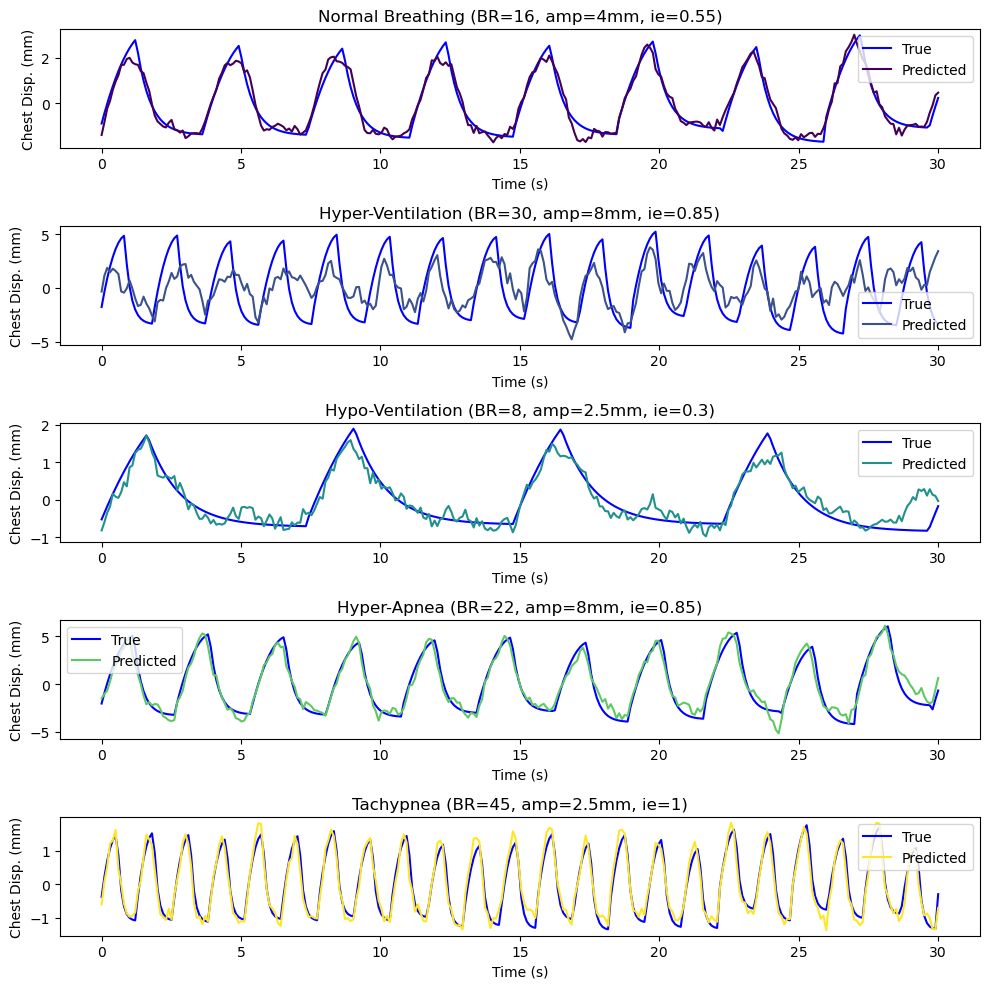 Figure 1: Comparison of true breathing waveforms versus model predictions after training on a limited dataset of 200 samples. 5 validation phase waveforms representing abnormal breathing types (hyper-ventilation, hypo-ventilation, hyper-apnea, and tachypnea) were input into the network. For future training, more waveforms with increased IE ratio and amplitude will be used in order to improve the hyper-ventilation cases.
Background and Implementation:
Detecting vital signatures with radar is becoming more common for human detection because it is more private than camera-based systems and sensitive to chest movements due to the heart beat.
I fully automated a process that generated anatomically accurate breathing patterns with variable amplitude, breath rate, and inspiration to expiration (IE) ratios using python. These waveforms were imported into a Blender project using the Python bpy toolbox to animate CAD objects with the breathing waveform.
To call blender 200+ times to generate a library of CAD models, I wrapped the call to blender with a Windows Batch script to loop over multiple directories and outputs. These objects were then loaded automatically into Remcom’s ray tracer using a JavaScript workflow.
The phase data with the corresponding breathing waveform were input into a CNN to train it. The result was a large synthetic dataset.
To adjust the learning rate, batch size, and NN architecture, I ran the CNN inside of a jupyter notebook for fast iteration and adjustments.
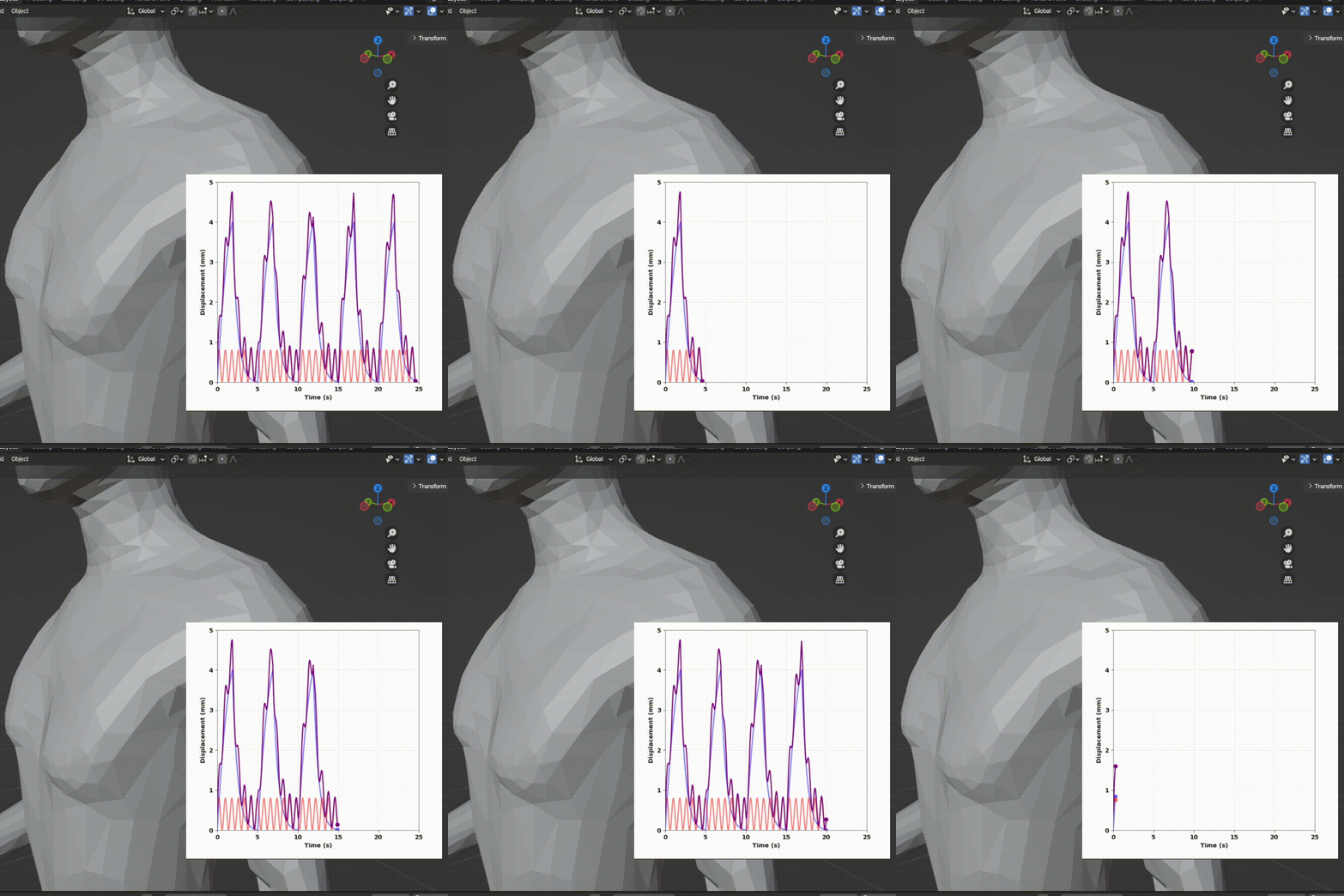 Figure 2: Example breathing animation inside of Blender. The chest displacement follows a known mathematical model for breathing. Heart rate was also super-imposed as a simple sinusoidal waveform.
If you want to read more about this project, the two-page paper is on IEEE Xplore.